| Size: | |
|---|---|
| Orientation: | |
| Availability: | |
| Quantity: | |
JSD
INFI
CVD Single crystal diamond substrate Diamond gold plated heat sink Diamond metallization
Depositing a thin film of gold (Au) on the surface of Chemical Vapor Deposition (CVD) single-crystal diamond is a critical process for material functionalization and device integration. While diamond possesses extreme physical and chemical properties (e.g., supreme hardness, highest thermal conductivity, wide bandgap, biocompatibility), the gold coating provides excellent electrical, thermal, and optical interfacial characteristics.
Electrical Contact: To fabricate low-resistance, stable ohmic or Schottky contact electrodes for diamond-based electronic devices (e.g., detectors, diodes, transistors). Gold's high electrical conductivity and chemical inertness make it an ideal choice.
Thermal Management: To serve as an efficient thermal interface material. Combining diamond's supreme bulk thermal conductivity with gold's high in-plane conductivity significantly reduces the interfacial thermal resistance between devices and heat sinks, crucial for high-power lasers, RF devices, etc.
Optical Functionalization: To act as a high-performance reflective or filter coating, especially for optical windows, laser mirrors, and biochemical sensors utilizing surface plasmon resonance (SPR) effects in the IR to UV spectrum.
Chemical Protection & Bonding: To protect the diamond surface from high-temperature oxidation or chemical corrosion. Additionally, the gold layer facilitates high-reliability packaging integration via soldering or eutectic bonding (e.g., Au-Sn).
Quantum Technology: In diamond quantum devices based on nitrogen-vacancy (NV) centers, patterned gold structures function as microwave antennas or electrodes for precise manipulation and readout of electron spin states.
Due to the high chemical inertness of diamond, direct gold deposition results in poor adhesion. A multi-layer metallization scheme is typically employed:
Surface Pretreatment: Cleaning and activating the diamond surface via acid cleaning, oxygen plasma treatment, etc.
Adhesion Layer Deposition: First, a very thin (~10-50 nm) layer of reactive metal, such as Titanium (Ti) or Chromium (Cr), is sputtered or evaporated. These metals form strong chemical bonds with carbon atoms on the diamond surface, providing anchoring.
Gold Layer Deposition: The main gold layer of desired thickness (tens of nm to several μm) is deposited atop the adhesion layer. Common methods include electron-beam evaporation, magnetron sputtering, or electroplating.
Patterning (Optional): Photolithography and etching techniques are used to pattern the continuous metal film into specific electrode or circuit geometries.
Annealing (Optional): A low-temperature anneal in an inert atmosphere may be performed to improve the contact properties at the metal-diamond interface and reduce contact resistance.
Adhesion: Ensuring the Ti/Au or Cr/Au multilayer structure does not delaminate under thermal cycling or mechanical stress is paramount. Control of interfacial reactions and roughness is critical.
High-Temperature Stability: Gold tends to diffuse into other layers at elevated temperatures, potentially compromising long-term device reliability. A diffusion barrier layer (e.g., Pt, Ni) is sometimes needed.
Interfacial Resistance: For electronic devices, optimizing the barrier height and contact resistance between the metal and doped diamond is key to performance.
Cost: Gold is a precious metal, necessitating a balance between performance and cost, often achieved through selective deposition on critical areas.
High-Power/High-Frequency Electronics: Heat spreaders and gate/drain electrodes for diamond-based GaN power amplifiers.
Particle & Radiation Detectors: Signal collection electrodes for X-ray, UV, and charged particle detectors.
Bio/Chemical Sensors: SPR sensor chips for highly sensitive detection of molecular interactions.
Quantum Information & Sensing: Microwave resonator structures in NV-center-based magnetometers and gyroscopes.
Aerospace Optical Windows: Ultra-durable, high-reflectivity protective coatings.
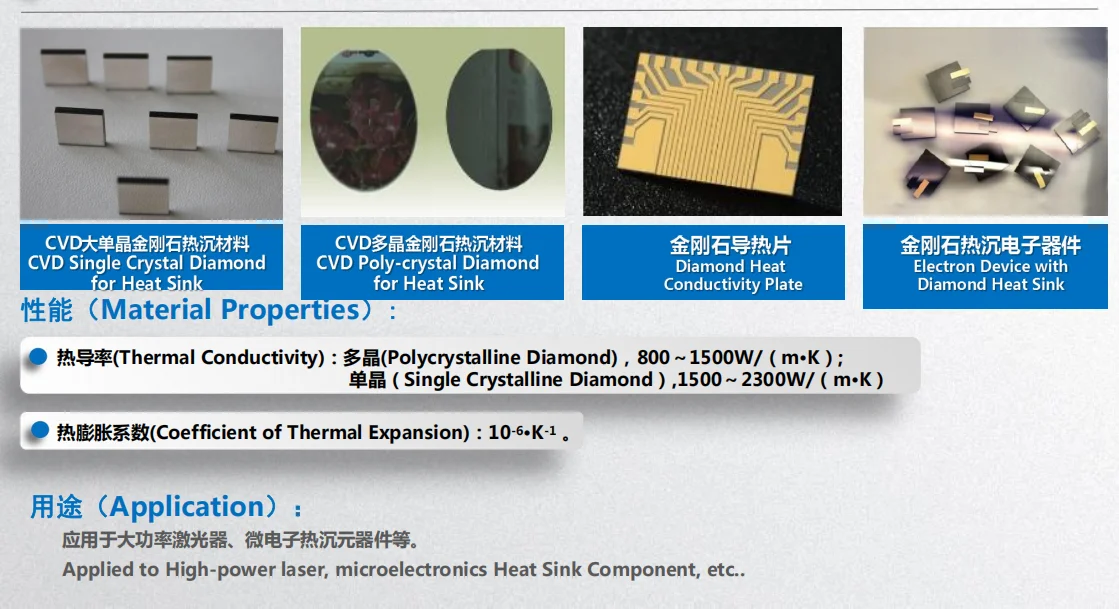
I. Primary Purposes of Metallization
1,Electrical Interfacing & Electrode Fabrication
Purpose: To form ohmic contacts, Schottky contacts, or patterned electrodes for electronic devices (e.g., FETs, diodes), radiation detectors, and electrochemical sensors.
How: Photolithography and metal deposition create precise conductive circuits and bonding pads on the diamond surface.
2,Thermal Integration (Heat Spreading/Dissipation)
Purpose: To enable the reliable, low-thermal-resistance attachment of a diamond heat spreader/sink to a heat-generating device (e.g., laser diode, power amplifier) or a cooling system via soldering or brazing.
How: A metallization stack acts as a solderable layer and diffusion barrier, creating a strong metallurgical bond between the diamond and an external metal mount (e.g., copper, copper-tungsten).
3,Optical Coating
Purpose: To deposit highly reflective metal films (e.g., Au, Ag) on the edges or specific areas of diamond optical windows, lenses, or laser crystals to serve as mirrors or protective coatings.
How: Gold's excellent infrared reflectivity is utilized to create high-performance reflective surfaces on diamond optics.
4,Surface Modification
Purpose: To alter surface properties—such as wear resistance for non-active areas, chemical affinity, or adhesion for subsequent layers—through coatings like chromium.
II. Advantages and Selection of Specific Metal Coatings
The choice of metal depends on the application requirements and the interfacial adhesion chemistry. Metallization is typically a multilayer stack consisting of an "adhesion layer" and a "functional layer."
Metal | Key Advantages | Typical Application & Rationale |
Titanium / Chromium | The Ultimate Adhesion Layer. Ti or Cr reacts with surface carbon atoms to form strong, refractory carbides (TiC, Cr$_3$C$_2$), providing exceptional mechanical anchoring and chemical bonding. This is the essential foundation for most subsequent layers. | Mandatory First Layer: Used as the initial coating for any electrical or thermal connection requiring high adhesion. E.g., the first layer in Ti/Pt/Au or Cr/Pt/Au stacks. |
Gold | The Premium Functional Top Layer. Extremely chemically inert (does not oxidize), offers excellent electrical and thermal conductivity, is highly solderable (e.g., Au-Sn eutectic), and is ideal for wire bonding. | Primary Top Layer: Used for high-frequency electrodes, high-reliability ohmic contacts, optical mirrors, and any application requiring oxidation resistance and easy packaging. |
Silver | High-Performance Alternative. Possesses the highest electrical and thermal conductivity of all metals, with a lower cost than gold. The critical drawback is susceptibility to oxidation and sulfurization, degrading performance and solderability. | Niche Applications: Used for cost-sensitive internal conductive/thermal layers in sealed environments, or for devices requiring ultimate conductivity. Rarely used as an exposed top layer. |
Copper | The Cost-Effective Thermal Champion. Exceptional thermal conductivity (second only to silver) at a much lower cost than Au or Ag. It is the ideal bulk thermal connection layer. Requires protection from oxidation. | Core of Heat Sink Applications: A Ti/Cu or Cr/Cu stack on diamond allows for brazing or sintering to copper substrates, creating a high-performance thermal pathway. |
Platinum / Palladium | Noble Diffusion Barriers. Highly inert metals that effectively prevent interdiffusion between adjacent layers (e.g., Ti and Au) during high-temperature operation or processing, ensuring long-term interfacial stability. | Critical Intermediate Layer: A thin Pt or Pd layer inserted between Ti/Au or Cr/Au dramatically improves device reliability under thermal stress. |
Enables Electrical "Dialogue": It allows the inherently insulating or semiconducting diamond to conduct electrical signals and current, integrating it into circuits.
Unlocks Ultimate Thermal Potential: It facilitates the efficient extraction of heat from the diamond's interior to an external system via low-thermal-resistance, robust bonds. This is the key to its application in 5G, laser, and aerospace thermal management.
Enhances Device Reliability & Lifespan: A robust metallization scheme withstands thermal cycling, mechanical stress, and environmental exposure, ensuring long-term operational stability.
Enables Standard Microfabrication: It allows diamond devices to be processed, packaged, and tested using mature semiconductor industry techniques, promoting scalability and commercialization.
Size Available:
| Crystal growth process: | Mono crystal CVD diamond |
| Color: | Normal grade - Near colorless, Mechanic grade - Brown |
| Advantage: | 1) Regular shape, uniform size. The size can be strictly controlled according to customer needs. |
| 2) High repurchase rate and high cost performance, well received by customers. | |
| 3) No visible growth lines,under 100x microscope, no black spots, no impurities, no crack. | |
| 4) The stress is good, the number of times of reuse is high, and it is not easy to crac | |
| Size | 7*7 8*8 9*9 10*10 11*11 12*12 13*13 14*14 -20*20 Thickness: 0.05-3mm |
| Orientation: | 4pt/100 |
| Shape: | Square,Triangles, rectangles, swords |
| Lateral Dimensions Measured | to smaller side |
| Edges | Laser Cut |
| Laser Kerf | < 3° |
| Lateral Tolerance: | +0.1/-0 mm |
| Roughness, Ra | 1. Two sides polished, Ra <10- 30 nm |
| 2. One side polished, the other size is The other side is the cutting surface, or grow | |
| 3.Both sides are unpolished |
| Thermal Conductivity | ≥600 W/mK |
| Thermal Expansion Coefficient | 4.5-8 ppm/K(adjustable) |
| Density | 5.6 g/cm3 |
| Surface Modification | Chrome, Nickel |
| Transition Layer | Titanium, Platinum |
| Contact Layer | Gold, Copper |
| Crystallographic Orientation | 100 110 111 |
| Miscut for Main Face Orientation | ±3° |
| Common Product Size | 3mm×5mm×0.5mm |
| Transverse Tolerance | ±0.05mm |
| Thickness Tolerance | ±0.1mm |
| Edge Cutting | Laser Cutting |
Picture details:


CVD Single crystal diamond substrate Diamond gold plated heat sink Diamond metallization
Depositing a thin film of gold (Au) on the surface of Chemical Vapor Deposition (CVD) single-crystal diamond is a critical process for material functionalization and device integration. While diamond possesses extreme physical and chemical properties (e.g., supreme hardness, highest thermal conductivity, wide bandgap, biocompatibility), the gold coating provides excellent electrical, thermal, and optical interfacial characteristics.
Electrical Contact: To fabricate low-resistance, stable ohmic or Schottky contact electrodes for diamond-based electronic devices (e.g., detectors, diodes, transistors). Gold's high electrical conductivity and chemical inertness make it an ideal choice.
Thermal Management: To serve as an efficient thermal interface material. Combining diamond's supreme bulk thermal conductivity with gold's high in-plane conductivity significantly reduces the interfacial thermal resistance between devices and heat sinks, crucial for high-power lasers, RF devices, etc.
Optical Functionalization: To act as a high-performance reflective or filter coating, especially for optical windows, laser mirrors, and biochemical sensors utilizing surface plasmon resonance (SPR) effects in the IR to UV spectrum.
Chemical Protection & Bonding: To protect the diamond surface from high-temperature oxidation or chemical corrosion. Additionally, the gold layer facilitates high-reliability packaging integration via soldering or eutectic bonding (e.g., Au-Sn).
Quantum Technology: In diamond quantum devices based on nitrogen-vacancy (NV) centers, patterned gold structures function as microwave antennas or electrodes for precise manipulation and readout of electron spin states.
Due to the high chemical inertness of diamond, direct gold deposition results in poor adhesion. A multi-layer metallization scheme is typically employed:
Surface Pretreatment: Cleaning and activating the diamond surface via acid cleaning, oxygen plasma treatment, etc.
Adhesion Layer Deposition: First, a very thin (~10-50 nm) layer of reactive metal, such as Titanium (Ti) or Chromium (Cr), is sputtered or evaporated. These metals form strong chemical bonds with carbon atoms on the diamond surface, providing anchoring.
Gold Layer Deposition: The main gold layer of desired thickness (tens of nm to several μm) is deposited atop the adhesion layer. Common methods include electron-beam evaporation, magnetron sputtering, or electroplating.
Patterning (Optional): Photolithography and etching techniques are used to pattern the continuous metal film into specific electrode or circuit geometries.
Annealing (Optional): A low-temperature anneal in an inert atmosphere may be performed to improve the contact properties at the metal-diamond interface and reduce contact resistance.
Adhesion: Ensuring the Ti/Au or Cr/Au multilayer structure does not delaminate under thermal cycling or mechanical stress is paramount. Control of interfacial reactions and roughness is critical.
High-Temperature Stability: Gold tends to diffuse into other layers at elevated temperatures, potentially compromising long-term device reliability. A diffusion barrier layer (e.g., Pt, Ni) is sometimes needed.
Interfacial Resistance: For electronic devices, optimizing the barrier height and contact resistance between the metal and doped diamond is key to performance.
Cost: Gold is a precious metal, necessitating a balance between performance and cost, often achieved through selective deposition on critical areas.
High-Power/High-Frequency Electronics: Heat spreaders and gate/drain electrodes for diamond-based GaN power amplifiers.
Particle & Radiation Detectors: Signal collection electrodes for X-ray, UV, and charged particle detectors.
Bio/Chemical Sensors: SPR sensor chips for highly sensitive detection of molecular interactions.
Quantum Information & Sensing: Microwave resonator structures in NV-center-based magnetometers and gyroscopes.
Aerospace Optical Windows: Ultra-durable, high-reflectivity protective coatings.
I. Primary Purposes of Metallization
1,Electrical Interfacing & Electrode Fabrication
Purpose: To form ohmic contacts, Schottky contacts, or patterned electrodes for electronic devices (e.g., FETs, diodes), radiation detectors, and electrochemical sensors.
How: Photolithography and metal deposition create precise conductive circuits and bonding pads on the diamond surface.
2,Thermal Integration (Heat Spreading/Dissipation)
Purpose: To enable the reliable, low-thermal-resistance attachment of a diamond heat spreader/sink to a heat-generating device (e.g., laser diode, power amplifier) or a cooling system via soldering or brazing.
How: A metallization stack acts as a solderable layer and diffusion barrier, creating a strong metallurgical bond between the diamond and an external metal mount (e.g., copper, copper-tungsten).
3,Optical Coating
Purpose: To deposit highly reflective metal films (e.g., Au, Ag) on the edges or specific areas of diamond optical windows, lenses, or laser crystals to serve as mirrors or protective coatings.
How: Gold's excellent infrared reflectivity is utilized to create high-performance reflective surfaces on diamond optics.
4,Surface Modification
Purpose: To alter surface properties—such as wear resistance for non-active areas, chemical affinity, or adhesion for subsequent layers—through coatings like chromium.
II. Advantages and Selection of Specific Metal Coatings
The choice of metal depends on the application requirements and the interfacial adhesion chemistry. Metallization is typically a multilayer stack consisting of an "adhesion layer" and a "functional layer."
Metal | Key Advantages | Typical Application & Rationale |
Titanium / Chromium | The Ultimate Adhesion Layer. Ti or Cr reacts with surface carbon atoms to form strong, refractory carbides (TiC, Cr$_3$C$_2$), providing exceptional mechanical anchoring and chemical bonding. This is the essential foundation for most subsequent layers. | Mandatory First Layer: Used as the initial coating for any electrical or thermal connection requiring high adhesion. E.g., the first layer in Ti/Pt/Au or Cr/Pt/Au stacks. |
Gold | The Premium Functional Top Layer. Extremely chemically inert (does not oxidize), offers excellent electrical and thermal conductivity, is highly solderable (e.g., Au-Sn eutectic), and is ideal for wire bonding. | Primary Top Layer: Used for high-frequency electrodes, high-reliability ohmic contacts, optical mirrors, and any application requiring oxidation resistance and easy packaging. |
Silver | High-Performance Alternative. Possesses the highest electrical and thermal conductivity of all metals, with a lower cost than gold. The critical drawback is susceptibility to oxidation and sulfurization, degrading performance and solderability. | Niche Applications: Used for cost-sensitive internal conductive/thermal layers in sealed environments, or for devices requiring ultimate conductivity. Rarely used as an exposed top layer. |
Copper | The Cost-Effective Thermal Champion. Exceptional thermal conductivity (second only to silver) at a much lower cost than Au or Ag. It is the ideal bulk thermal connection layer. Requires protection from oxidation. | Core of Heat Sink Applications: A Ti/Cu or Cr/Cu stack on diamond allows for brazing or sintering to copper substrates, creating a high-performance thermal pathway. |
Platinum / Palladium | Noble Diffusion Barriers. Highly inert metals that effectively prevent interdiffusion between adjacent layers (e.g., Ti and Au) during high-temperature operation or processing, ensuring long-term interfacial stability. | Critical Intermediate Layer: A thin Pt or Pd layer inserted between Ti/Au or Cr/Au dramatically improves device reliability under thermal stress. |
Enables Electrical "Dialogue": It allows the inherently insulating or semiconducting diamond to conduct electrical signals and current, integrating it into circuits.
Unlocks Ultimate Thermal Potential: It facilitates the efficient extraction of heat from the diamond's interior to an external system via low-thermal-resistance, robust bonds. This is the key to its application in 5G, laser, and aerospace thermal management.
Enhances Device Reliability & Lifespan: A robust metallization scheme withstands thermal cycling, mechanical stress, and environmental exposure, ensuring long-term operational stability.
Enables Standard Microfabrication: It allows diamond devices to be processed, packaged, and tested using mature semiconductor industry techniques, promoting scalability and commercialization.
Size Available:
| Crystal growth process: | Mono crystal CVD diamond |
| Color: | Normal grade - Near colorless, Mechanic grade - Brown |
| Advantage: | 1) Regular shape, uniform size. The size can be strictly controlled according to customer needs. |
| 2) High repurchase rate and high cost performance, well received by customers. | |
| 3) No visible growth lines,under 100x microscope, no black spots, no impurities, no crack. | |
| 4) The stress is good, the number of times of reuse is high, and it is not easy to crac | |
| Size | 7*7 8*8 9*9 10*10 11*11 12*12 13*13 14*14 -20*20 Thickness: 0.05-3mm |
| Orientation: | 4pt/100 |
| Shape: | Square,Triangles, rectangles, swords |
| Lateral Dimensions Measured | to smaller side |
| Edges | Laser Cut |
| Laser Kerf | < 3° |
| Lateral Tolerance: | +0.1/-0 mm |
| Roughness, Ra | 1. Two sides polished, Ra <10- 30 nm |
| 2. One side polished, the other size is The other side is the cutting surface, or grow | |
| 3.Both sides are unpolished |
| Thermal Conductivity | ≥600 W/mK |
| Thermal Expansion Coefficient | 4.5-8 ppm/K(adjustable) |
| Density | 5.6 g/cm3 |
| Surface Modification | Chrome, Nickel |
| Transition Layer | Titanium, Platinum |
| Contact Layer | Gold, Copper |
| Crystallographic Orientation | 100 110 111 |
| Miscut for Main Face Orientation | ±3° |
| Common Product Size | 3mm×5mm×0.5mm |
| Transverse Tolerance | ±0.05mm |
| Thickness Tolerance | ±0.1mm |
| Edge Cutting | Laser Cutting |
Picture details:

